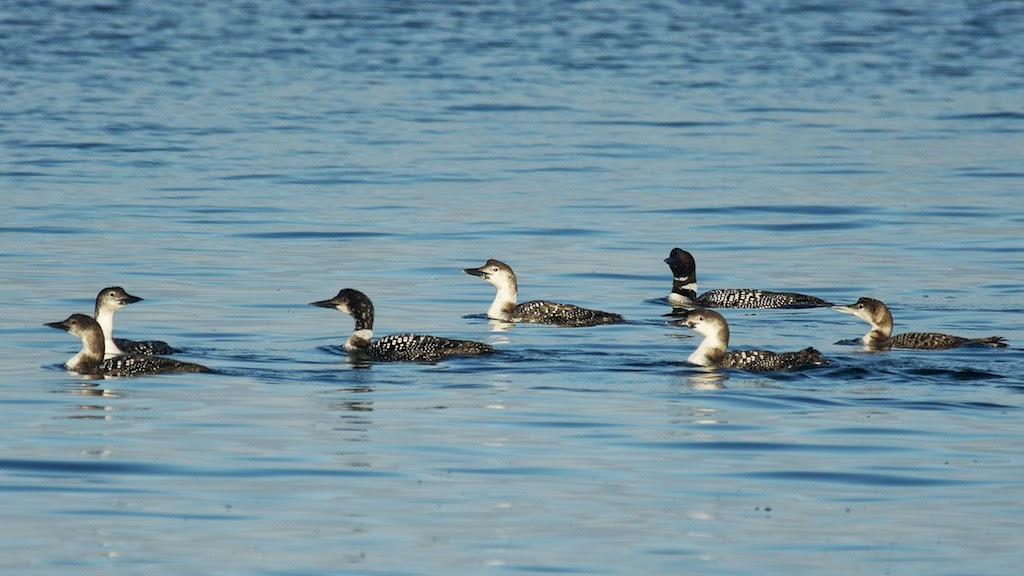
April 20, 2014

Gavia immer

Sci: Gavia immer, No: Islom, Eng: Great northern diver, It: Strolaga maggiore

Dear All,
We are just back from a wonderful easter-week at the Buchanan estate, Loch Morar, Scotland. Thanks! The Great northern diver is an exciting bird, which stays at the coast of Scotland in the winter and migrates to Iceland to breed in the summer. It was nice to see that there were both birds in winter plumage (white and grey head) and summer plumage (black head). I found it very exciting when a beautiful bird in summer suit dived down to find a Plaice (Rødspette) for breakfast. Normally they are quite far out, but this was close to the shore.

Best regards,
Hans


March 16, 2014

Ciconia ciconia

Sci: Ciconia ciconia, No: Stork, Eng: White stork, It: Cicogna bianca

Dear all,
This month I post a bird after two weeks in Madrid. The White Stork is perhaps the most typical bird in Spain. In cities like Segovia (below) storks nest on the rooftops.

The Mystery of the non-migrating Storks: For ages storks have migrated to Africa in the winter. Since they need warm up-winds to fly, they cannot cross the wide parts of the Mediterranean, and must cross either over Gibraltar or through the Middle East. This is one reason why Spain has more storks than any other European country (> 30.000). Then, in the 1980s, they learned that it might be easier to stop migrating and stay in Spain also in the winter. Instead of feeding on frogs and snakes, they found 'junk food' to feed on in the garbage land fill sites. So, nowadays storks are seen in Spain also in the winter. Why this change in behaviour? Nobody knows, but it is being investigated. I believe that they just learn from each other. Learning has been observed in other bird species. Read more: Why has Storks Stopped Migraging (Science Daily).

Interestingly, the fertility rate in Spain dropped dramatically from the 1950s until exactly the moment the Storks stopped migrating. From that point on, the curve flattened, and even started to climb! Fertility in Spain.

Best regards,
Hans


February 08, 2014

Turdus atrogularis

Sci: Turdus atrogularis, No: Svartstrupetrost, Eng: Black-throated thrush, It: Tordo golanera

Dear All,
The bird of this month is very rare! It has only been seen 30 times in Norway since 1886. It belongs to the taiga east of Ural, and this female bird suddenly became a celebrity in Bergen when it navigated completely wrong and appeared in a garden two weeks ago (Bergens Tidende)

Thanks a lot to Ellen Sophie Thobro and Lars Atle Lauvås for their great hospitality, and thanks to Harald T. for accompanying me on this highly adventurous excursion. A rather unusual birding trip to sit in a warm living room with a cup of  coffee and wait for a 3-star rare bird to appear outside the window!

Best regards,
Hans

PS: This is a female and therefore doesn't have a black throat.


January 22, 2014

Falco peregrinus

Sci: Falco peregrinus, No: Vandrefalk, Eng: Peregrine Falcon, It: Falco pellegrino


Dear All,
The bird of this month is a 'well known character' (byoriginal?) in Bergen. In the winter, it often sits on the top of the tall City Hall and hunts pigeons. My challenge this month was to get a good photo from top of the roof. First attempt, Jan. 15 with camouflage tent, was not successful. I scared it and it didn't return in an hour. However, second attempt, Jan. 22, was much better!

Enjoy!

Hans


A killer with the dagger hidden under the coat ...
Seen from the street below: