June 30, 2014

Cuculus canorus

No: Gjøk, Eng: Cuckoo, It: Cuculo

Dear All,
The cuckoo is an important sign of spring/ summer. Traditionally, children in Norway are not allowed to walk barefoot before they have heard the cockoo.
They never see it, since it is rather shy. I met this in the mountain above our cabin at Ustaoset, June 1. It was hiding well among the mountain rock.
In the film-snippet below you can see it fly, a bit similar to a falcon.

Best regards,
Hans


May 31, 2014

Gavia stellata

Sci: Gavia stellata, No: Smålom, Eng: Red-throated diver, It: Strolaga minore

Dear All,
The May posting is a follow-up on April. I'm very fascinated by the arctic birds staying on the coasts in the winter and migrating to arctic inland habitats in the summer. I have followed the Red-throated diver on all its journey from the Scottish isles to the Norwegian mountains this spring, first in the Inner Hebridies in the easter, then during migration outside Skogsøy, Hordaland May 1, and finally in summer plumage at Lake Biskola, near Ustaoset in the Norwegian mountains now on May 31.

Best regards,
Hans

Summer plumage, Lake Biskola, Ustaoset May 31

Winter plumage, Inner Hebridies, Scotland, Easter.


Migration outside Skogsøy, Hordaland, Norway, May 1.


Everything below: Lake Biskola, Ustaoset, Norway, May 31.


April 20, 2014

Gavia immer

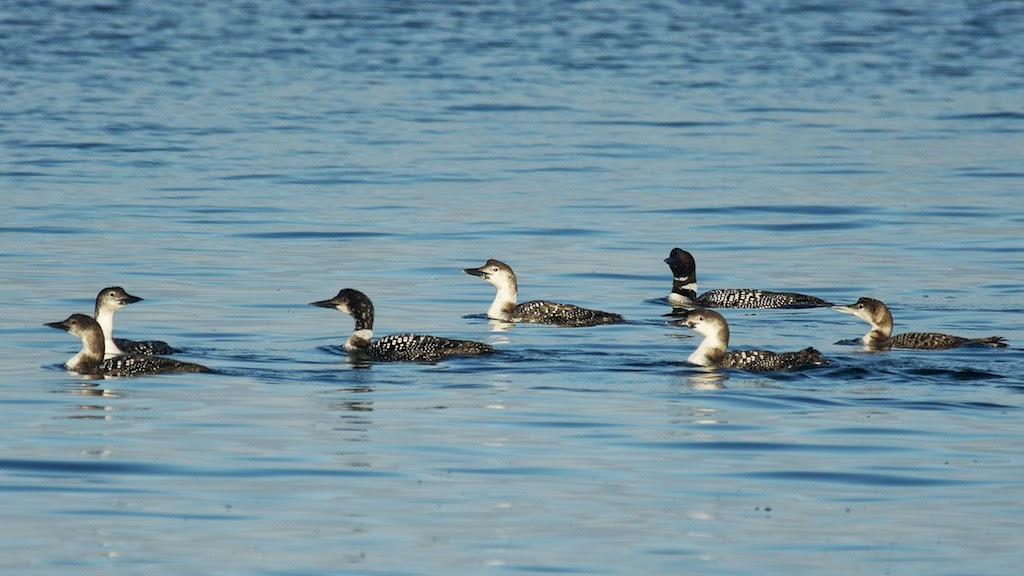
Sci: Gavia immer, No: Islom, Eng: Great northern diver, It: Strolaga maggiore

Dear All,
We are just back from a wonderful easter-week at the Buchanan estate, Loch Morar, Scotland. Thanks! The Great northern diver is an exciting bird, which stays at the coast of Scotland in the winter and migrates to Iceland to breed in the summer. It was nice to see that there were both birds in winter plumage (white and grey head) and summer plumage (black head). I found it very exciting when a beautiful bird in summer suit dived down to find a Plaice (Rødspette) for breakfast. Normally they are quite far out, but this was close to the shore.

Best regards,
Hans


March 16, 2014

Ciconia ciconia

Sci: Ciconia ciconia, No: Stork, Eng: White stork, It: Cicogna bianca

Dear all,
This month I post a bird after two weeks in Madrid. The White Stork is perhaps the most typical bird in Spain. In cities like Segovia (below) storks nest on the rooftops.

The Mystery of the non-migrating Storks: For ages storks have migrated to Africa in the winter. Since they need warm up-winds to fly, they cannot cross the wide parts of the Mediterranean, and must cross either over Gibraltar or through the Middle East. This is one reason why Spain has more storks than any other European country (> 30.000). Then, in the 1980s, they learned that it might be easier to stop migrating and stay in Spain also in the winter. Instead of feeding on frogs and snakes, they found 'junk food' to feed on in the garbage land fill sites. So, nowadays storks are seen in Spain also in the winter. Why this change in behaviour? Nobody knows, but it is being investigated. I believe that they just learn from each other. Learning has been observed in other bird species. Read more: Why has Storks Stopped Migraging (Science Daily).

Interestingly, the fertility rate in Spain dropped dramatically from the 1950s until exactly the moment the Storks stopped migrating. From that point on, the curve flattened, and even started to climb! Fertility in Spain.

Best regards,
Hans